 Skip to content
Affiliate Marketing · Income
Short answer: anywhere from $0 to well over six figures a year, and most beginners are at the bottom of that range for their first months. The often-quoted “$8,038 a month average” comes from a 2023 survey of 2,270 readers of one affiliate-marketing website, and it’s an average pulled up by top earners, not a typical result. Real leaderboard data from a ClickBank program shows the same shape: a few members earn thousands a month, and most earn very little. Your income comes down to three numbers: how many people click your links, how many of them buy, and how much you earn per sale.
Search this question and you’ll find the same statistics copied from article to article: “$8,038 a month”, “9.45x more”, “81% earn over $20,000”. Most of those articles don’t say where the numbers come from, who was surveyed, or what they actually measure.
This article traces each figure back to its original source and explains what it does and doesn’t tell you. Then it shows what you’d earn per sale on real programs, how recurring commissions stack up, and how long it realistically takes. I’ve worked as an affiliate for about six years on ClickBank, JVZoo, WarriorPlus and Digistore24, so I’ll also be straight about what the first year usually looks like.
If you haven’t picked a program yet, my guide to the best affiliate programs for beginners compares commissions and payout rules for ten of them.
In this article
- What the data actually says
- Why the “$8,038 a month” average misleads
- Affiliate marketing salary vs your own business
- What real affiliates in one program earn
- How much you earn per sale
- How recurring commissions stack up
- Income scenarios: the maths
- How long it takes to earn
- Income vs costs: what you keep
- What higher earners do differently
- The fastest way to your first commission
- FAQ
What the data actually says
There’s no official government statistic for affiliate income, because most affiliates are self-employed and report it as general business income. What exists are a few data sources, each measuring something different:
| Source | What it measures | Figure | The catch |
|---|---|---|---|
| Authority Hacker survey (Sept 2023) | Self-reported income of 2,270 affiliates | $8,038 a month on average | An average, not a typical result; respondents came from the site’s own audience |
| Same survey | Income by experience | 3+ years’ experience earn 9.45x more than beginners | Shows how slowly income builds in the early years |
| ZipRecruiter (July 2026) | Salaries for affiliate marketing jobs in the US | $82,015 a year on average | Employees running programs for companies, not self-employed affiliates |
| CB Profit Club leaderboard (Oct 2026) | Actual tracked sales by every member of one ClickBank program | About $23 in sales per member, on average | One program, gross sales rather than take-home pay, but it includes everyone, not just people who chose to answer a survey |
Read together, they say the same thing: affiliate marketing can pay a full-time income, but the people earning it are a minority who’ve usually been at it for years.
Why the “$8,038 a month” average misleads
The $8,038 figure is real. It comes from Authority Hacker’s survey of 2,270 affiliate marketers, published in September 2023. But there are three reasons not to read it as “what affiliates make”:
- It’s an average, not a median. A handful of people earning $100,000 a month pull the average far above what most respondents earn. If nine people earn $0 and one earns $80,000, the average is $8,000, and nobody earns anything close to it.
- The respondents aren’t a random sample. They were reached through Authority Hacker’s email list, podcast and social channels: people already invested enough in affiliate marketing to follow an affiliate-marketing business. Respondents averaged 2.8 years of experience, and the audience is mostly website owners.
- People who quit don’t answer surveys. Anyone who tried affiliate marketing, made nothing and gave up is mostly missing from the results. That’s called survivorship bias, and it makes every self-reported income survey look better than reality.
The more useful findings from the same survey are the less exciting ones: affiliates with 3+ years of experience earn 9.45 times more than beginners, and 45.3% say getting traffic is their biggest challenge. In other words, income grows slowly, and traffic is the bottleneck.
Affiliate marketing salary vs your own business
Some of the “how much do affiliate marketers make” results are salary data, which measures something different. According to ZipRecruiter (July 2026), US jobs titled “affiliate marketing” pay:
| Percentile | Annual pay |
|---|---|
| 25th percentile | $66,000 |
| Average | $82,015 ($39.43 an hour) |
| 75th percentile | $99,500 |
| 90th percentile | $125,000 |
These are employees: people who manage a company’s affiliate program, recruit partners and run campaigns, for a salary. It’s a real career, and the skills overlap. But it isn’t what most people mean when they ask this question. If you promote products with your own links, there’s no salary. You earn commissions, and only when people buy.
What real affiliates in one program earn
Survey answers are self-reported. Leaderboards aren’t. CB Profit Club, a ClickBank affiliate program, shows a live “Hall of Fame” of every member’s tracked sales inside its members area. Here’s what it showed in October 2026:
| Gross sales | #1 member | #10 member |
|---|---|---|
| Last 30 days | $3,631.15 | $816.28 |
| All time | $76,721.02 | $4,096.78 |
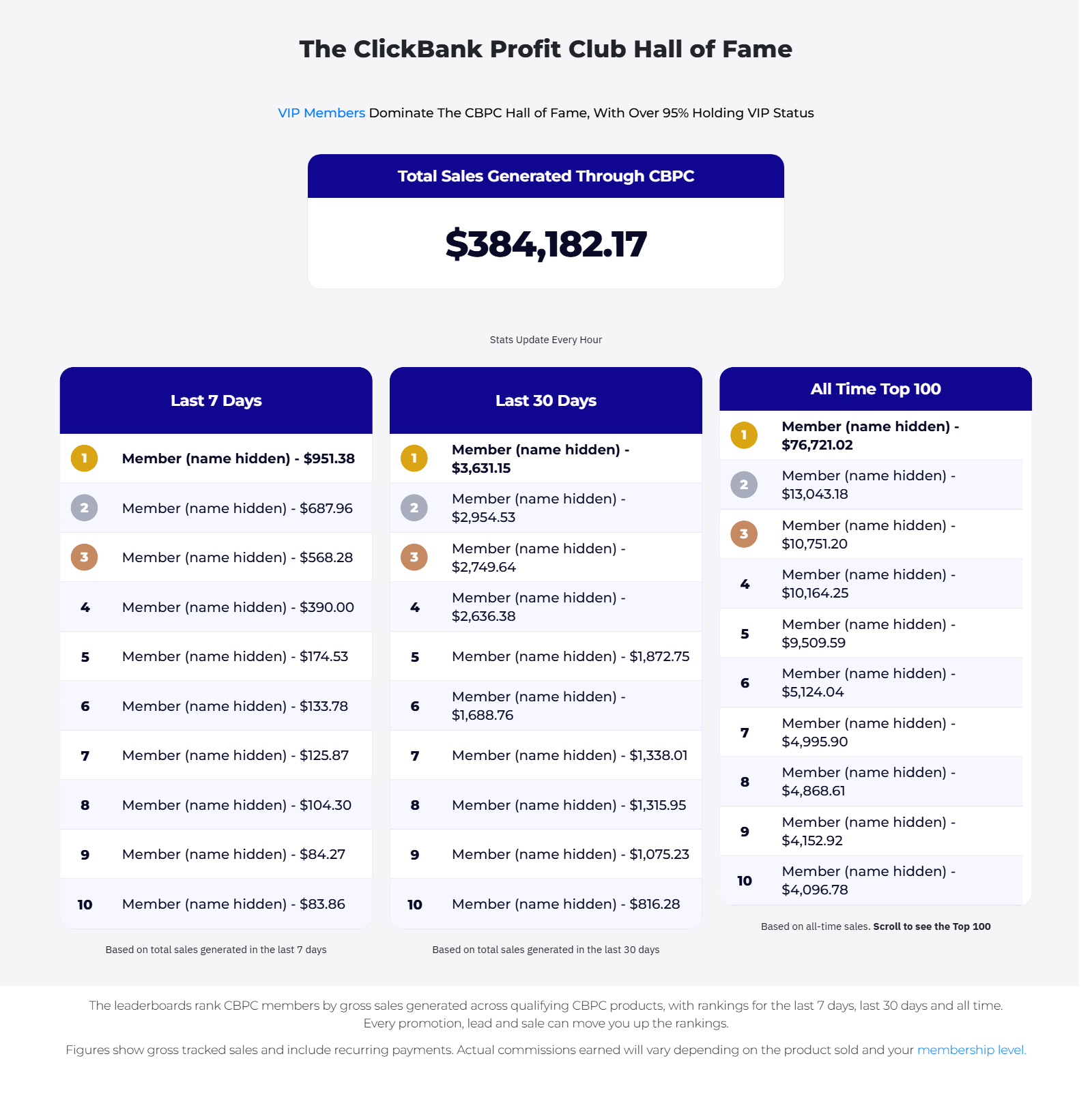
The 100th member, all time, was at $393.24. The club’s total tracked sales were $384,182.17, and its sales page says more than 16,914 members have joined. That works out to roughly $23 in sales per member on average (the two figures were published at different times, so treat it as a rough guide).
That’s the real distribution of affiliate income in one picture: a top earner making several thousand dollars a month, a top ten making hundreds, and most members making little or nothing, mainly because most never build a source of traffic. My CB Profit Club review covers the program itself in detail.
How much you earn per sale
Before you can estimate income, you need to know what one sale pays. It varies enormously by program. These figures use each program’s published commission rate and price, checked in October 2026:
| Program | Commission | You earn per sale |
|---|---|---|
| Amazon Associates | 4.5% on kitchen items | $4.50 on a $100 blender, once |
| Systeme.io | 60% recurring, for life | $10.20 a month for each customer on the $17 Startup plan |
| Kit | 50% for 12 months | $16.50 a month on the $33 Creator plan, for a year |
| GoHighLevel | 40% recurring | $38.80 a month on the $97 plan |
| CB Profit Club (free Team tier) | 50% on upgrades | $247.50 on a $495 annual VIP upgrade |
The same effort can be worth $4.50 or $247.50, depending on what you promote. That’s why choosing a program matters more than most beginners think, and why low-commission programs like Amazon need very high traffic to add up. For higher-paying programs, see my guide to high-ticket affiliate marketing.
How recurring commissions stack up
A one-time commission has to be earned again next month. A recurring commission keeps paying for as long as the customer stays, so every new customer adds to the last. This is how modest affiliate incomes grow without needing more traffic every month.
Here’s an example with Systeme.io’s 60% lifetime commission on its $17 Startup plan ($10.20 a month per customer), assuming you refer five new paying customers a month and nobody cancels:
| Month | Active customers | Monthly commission |
|---|---|---|
| Month 1 | 5 | $51 |
| Month 6 | 30 | $306 |
| Month 12 | 60 | $612 |
| Month 24 | 120 | $1,224 |
In reality some customers will cancel, so the real curve is flatter. But the shape is the point: the same five referrals a month that earn you $51 in month one earn you over $1,000 a month by year two. One-time commissions can’t do that.
Income scenarios: the maths
All affiliate income comes from one formula:
Monthly income = clicks on your links × conversion rate × commission per sale
Here’s how it plays out at different levels. These are illustrations, not predictions: conversion rates vary a lot by product, traffic source and how well your audience matches the offer.
| Stage | Clicks a month | Conversion | Commission | Monthly income |
|---|---|---|---|---|
| Starting out | 100 | 1% | $30 | $30 |
| Some traffic | 1,000 | 2% | $30 | $600 |
| Established | 5,000 | 2% | $50 | $5,000 |
| Large site or list | 20,000 | 3% | $50 | $30,000 |
Two things stand out. First, the commission rate is decided the day you pick a program; traffic is what you have to build, and it starts near zero. Second, small improvements multiply: going from 1% to 2% conversion doubles your income without a single extra visitor. That’s why email follow-up matters so much, because it turns a one-time visitor into several chances to buy.
How long it takes to earn
How fast you earn depends mostly on where your traffic comes from:
- Search (SEO): slow to start, then durable. An Ahrefs study published in 2025 found only 1.74% of newly published pages reach Google’s top 10 within a year, and the average #1-ranking page is five years old. Choosing low-competition keywords improves your odds a lot, but plan on months, not weeks.
- YouTube and short-form video: can move faster if a video catches on, but results are uneven from one video to the next.
- Paid ads: the fastest way to a first sale, often within days, but you pay for every click, and many beginners lose money while they learn.
- Email: doesn’t create traffic on its own, but it raises the value of every visitor you do get, because you can follow up for weeks.
Then add the payment delay. Most programs hold commissions until their refund period passes, and some have extra rules for first payouts. ClickBank, for example, pays only after five sales from two different payment methods (details in my ClickBank review). Three to six months from starting to a first payment is normal for organic traffic, and the first year is usually the slowest.
Income vs costs: what you keep
Revenue isn’t profit. What you keep depends on your costs, your traffic method and taxes:
- Tools: a complete starter setup can cost $0, and a typical first paid setup is about $33 a month plus hosting. See the full breakdown in my guide to tools for affiliate marketing.
- Paid traffic: if you buy ads, your profit is commissions minus ad spend, and it can easily be negative while you test.
- Refunds: refunded sales reverse your commission, which is why products with high refund rates earn less than they look.
- Taxes: affiliate commissions are taxable income. I explain the US 1099 rules and what non-US affiliates fill in, in how you make money with affiliate marketing.
What higher earners do differently
The survey data and what I’ve seen in six years point the same way. People who earn well from affiliate marketing usually:
- Stay at it for years. The 9.45x gap between beginners and three-year affiliates is mostly time: content that ranks, lists that grow and recurring commissions that stack.
- Own one reliable traffic source before adding a second. Traffic is the biggest challenge for 45.3% of affiliates in the Authority Hacker survey.
- Build an email list, so a visitor who doesn’t buy today can still buy next week.
- Favour recurring and higher-ticket commissions, so each sale is worth more and keeps paying.
- Add other income streams. In the same survey, 82% of websites earning six figures a year combine display ads with affiliate products.
Be wary of anyone who promises a specific income from an affiliate “system”. That’s one of the clearest warning signs I cover in is affiliate marketing a scam?
The fastest way to your first commission
The quickest way to move from $0 is to remove the setup work that stops most beginners: building a landing page and writing follow-up emails before you’ve earned anything.
CB Profit Club’s free Team tier gives you a done-for-you funnel tagged with your ClickBank affiliate ID and a pre-written follow-up email campaign you import into your autoresponder. You earn 50% on upgrades, which is $247.50 on a $495 annual upgrade. You still need to bring visitors, but everything after the click is handled for you.
If you’re starting from zero, my step-by-step guide to affiliate marketing for beginners walks through your first 90 days, week by week.
The bottom line
How much you can make with affiliate marketing has no fixed ceiling, but the typical result in the first year is small, and the widely quoted averages describe experienced survivors, not beginners. What you earn comes from traffic, conversion and commission per sale. Choose programs that pay well and keep paying, build one traffic source, capture emails, and give it at least a year before judging the results.
To choose a program with good commissions and fair payout rules, compare all ten in my best affiliate programs for beginners.
FAQ
How much do affiliate marketers make per month on average?
The most-quoted figure is $8,038 a month, from Authority Hacker’s 2023 survey of 2,270 affiliates. It’s an average pulled up by high earners, taken from a self-selected audience with an average of 2.8 years’ experience, so it’s far above what most affiliates make, especially beginners.
How much do beginner affiliate marketers make?
Most beginners earn little or nothing in their first few months while they build traffic. In Authority Hacker’s survey, affiliates with three or more years of experience earned 9.45 times more than beginners. Three to six months to a first payment is normal with organic traffic.
Can you make $1,000 a month with affiliate marketing?
Yes, but how depends on the program. $1,000 a month is about 98 active Systeme.io Startup customers at $10.20 each, about four CB Profit Club annual upgrades at $247.50, or over 220 sales of a $100 kitchen item on Amazon at 4.5%. Higher commissions and recurring payments make it reachable with much less traffic.
What is the average affiliate marketing salary?
ZipRecruiter puts the average US salary for affiliate marketing jobs at $82,015 a year as of July 2026, with the 25th to 75th percentile between $66,000 and $99,500. Those are employees managing affiliate programs for companies, not self-employed affiliates earning commissions.
Can you get rich from affiliate marketing?
A small number of affiliates earn six or seven figures a year, usually after years of building traffic, email lists and recurring commissions. It’s possible, but it isn’t typical, and anyone promising it quickly is selling something.
Is affiliate marketing income passive?
Partly, once it’s built. Content that ranks and recurring commissions can keep earning without daily work. But getting there takes a lot of active work: creating content, building traffic and testing offers, often for a year or more.
How long does it take to make money with affiliate marketing?
With paid ads, a first sale can come within days, though often at a loss. With SEO, it usually takes months: an Ahrefs study found only 1.74% of new pages reach Google’s top 10 within a year. Add each program’s payment delay, and three to six months to a first payment is normal.