 Skip to content
Affiliate Marketing · Beginner’s Guide
Short answer: to start affiliate marketing as a beginner, pick a niche people spend money in, join one free affiliate program, choose one traffic channel, set up a free email capture page, and publish helpful content that recommends the product with a disclosed link. You can start for $0: every tool you need has a free plan. What it really costs is time, about 5 to 10 hours a week for at least three months before you should judge the results.
Most beginner guides make two assumptions that stop people before they start. They assume you already have a blog, or 10,000 followers. And they skip the practical questions: what this costs, which program to join when nobody will approve you, and what to actually do in week one.
This guide starts from zero: no website, no audience, no budget. It gives you the exact free tools, the order to do things in, and a week-by-week plan for your first 90 days. I’ve been doing affiliate marketing for about six years with ClickBank, JVZoo, WarriorPlus and Digistore24, and this is the order I’d follow if I were starting again today.
If you want to see which programs are worth joining first, my list of the best affiliate programs for beginners compares commissions, cookie windows and approval rules side by side.
In this guide
- What you need (and what you don’t)
- How much it costs to start
- Step 1: Choose a niche
- Step 2: Join your first program
- Step 3: Pick one traffic channel
- Step 4: Set up email capture (no website needed)
- Step 5: Create your first 10 pieces of content
- Step 6: Disclose, track and improve
- Your first 90 days, week by week
- 7 beginner mistakes to avoid
- FAQ
What you need (and what you don’t)
Here’s what’s actually required to start, and what people wrongly think they need:
| You need | You don’t need |
|---|---|
| To be 18 or older for most networks (ClickBank’s terms require it) | A website, at least not at the start |
| An email address and phone number for sign-ups | Followers or an existing audience |
| A bank account for direct deposit payouts | Money for ads or inventory |
| 5 to 10 hours a week, consistently | A paid course before you begin |
| Willingness to create content (written, video or email) | To show your face, though it can help |
| Patience: three months before judging results | Technical or coding skills |
The one thing you can’t skip is a way to put your recommendation in front of people who are looking for it. Everything in this guide is about building that from nothing.
New to how the money side works: how a click becomes a commission, payout minimums, taxes? Read how you make money with affiliate marketing first. This guide focuses on getting started.
How much it costs to start
You can genuinely start for $0. Here’s a complete free setup, with each tool’s limits taken from its official pricing page:
| What you need | Free option | Free plan limits | When you’d pay |
|---|---|---|---|
| Affiliate programs | ClickBank, Digistore24, Systeme.io’s affiliate program | Free to join, no approval needed | Never |
| Landing pages + email | Systeme.io | 2,000 contacts, 3 funnels, 1 automated email campaign, 1 blog, 1 custom domain, unlimited newsletters. No card, never expires. | Startup plan, $17/month, past 2,000 contacts |
| Email newsletter (alternative) | Kit | Up to 10,000 subscribers, unlimited landing pages, forms and broadcasts. No automations. | Creator plan, $33/month, for automated sequences |
| Graphics and thumbnails | Canva | Free plan | Optional |
| Search data | Google Search Console | Free | Never |
My recommendation: start on Systeme.io’s free plan. It gives you landing pages and one automated email sequence in one place, which is exactly what your first funnel needs, and the free plan covers your first 2,000 subscribers. Kit’s free plan holds more subscribers but can’t send automated sequences, which is the part that does the selling for you.
The only cost worth considering early is your own domain name (usually around $10 to $20 a year), so your pages look trustworthy. Hosting, paid tools and paid ads can all wait until you’ve made your first sales.
Step 1: Choose a niche
Your niche is the topic you’ll create content about. Beginners overthink this. Run your idea through three questions:
- Do people spend money on it? Software, online income, health, personal finance, hobbies with gear: yes. “Interesting facts”: no.
- Are there affiliate programs that pay well? Search “[your niche] affiliate program.” If you only find Amazon at 1% to 4%, the niche will be hard to earn from.
- Could you create 50 pieces of content about it? If you run out of ideas at ten, pick something broader.
Three niches that pass all three tests and suit beginners:
- Make money online / affiliate marketing itself. Huge demand, 50% or higher commissions on ClickBank and Digistore24, and lots of free tools to recommend.
- AI tools. Fast-growing, people actively search for how to use them, and many pay recurring commissions (Higgsfield up to 25%, ElevenLabs 22% for 12 months).
- Software for small businesses and creators. Email tools, funnel builders and website builders, many paying recurring commissions (Systeme.io pays 60% for life).
You don’t need to love your niche. You need to be curious enough to keep learning about it for a year.
Step 2: Join your first program
This is where many beginners get stuck: they apply to Amazon or a big brand, get rejected or ignored because they have no website or traffic, and give up. Avoid that by choosing your first program on four things:
- No approval barrier. ClickBank, Digistore24 and Systeme.io let you join and get a link immediately.
- A commission worth earning. 30% or more on digital products, or any recurring commission.
- A reasonable tracking window, so you still get credit when people come back later. Digistore24 tracks for 180 days. Amazon tracks for 24 hours.
- A product you’d actually recommend. Read the sales page and the refund policy. If you’d be embarrassed recommending it to a friend, skip it.
Why not start with Amazon? Amazon requires a website with original content to apply, and closes accounts that don’t make three qualifying sales within 180 days. Commissions are 1% to 10% depending on category. It works for established product sites, not as a first program.
How many programs should you join? One or two. Promoting ten products at once spreads your content too thin. You’ll learn more from building one offer to its first ten sales than from promoting ten offers that each get one click.
I compare ten beginner-friendly options, including commissions, cookie windows and approval rules, in the best affiliate programs for beginners.
Step 3: Pick one traffic channel
Traffic is the people who see your recommendation. Pick the channel that matches how you like to work, not the one that’s trending:
| If you… | Start with | Realistic pace |
|---|---|---|
| Like writing and can be patient | A blog targeting Google searches | Slow start (months), but articles keep earning for years |
| Are comfortable talking on camera, or doing voiceovers | YouTube | Slow to medium; videos keep getting search views |
| Don’t want to show your face | Faceless YouTube or short videos with screen recordings or voiceovers | Medium; depends on consistency |
| Want the fastest feedback | Short-form video (TikTok, Reels, Shorts) | Fast when a post takes off, but posts fade within days |
| Already have an audience anywhere | Email: move them onto your list | Fastest route to first sales |
Commit to one channel for 90 days. Switching every few weeks is the most common reason beginners never get a single sale: every channel takes a while to build momentum, and if you keep restarting, none of them ever gets there.
Step 4: Set up email capture (no website needed)
This is the step most beginner guides skip, and it’s the one that makes the biggest difference. Most people don’t buy the first time they see a recommendation. If you only send visitors straight to a sales page, you get one chance. If you collect their email first, you get many.
The setup is simple, and you don’t need a website for it:
- A landing page (also called a squeeze or bridge page) that offers something free and useful in exchange for an email address, such as a checklist, a short guide or a video.
- A thank-you page that delivers the freebie and introduces the product you recommend.
- A short automated email sequence (five to seven emails over a week or two) that teaches something useful and recommends the product with your link.
You can build all three on Systeme.io’s free plan, and send your traffic to the landing page’s link from YouTube, short videos or social posts. No hosting, no WordPress.
The done-for-you shortcut: if building pages and writing emails feels like too much for week one, CB Profit Club gives you the whole setup ready-made on its free Team tier. That’s a landing page and members area tagged with your ClickBank ID, plus a pre-written follow-up email campaign you import into your autoresponder. You earn 50% on upgrades your referred members buy. You still need to bring the traffic, but it removes the setup work and shows you a working funnel from the inside.
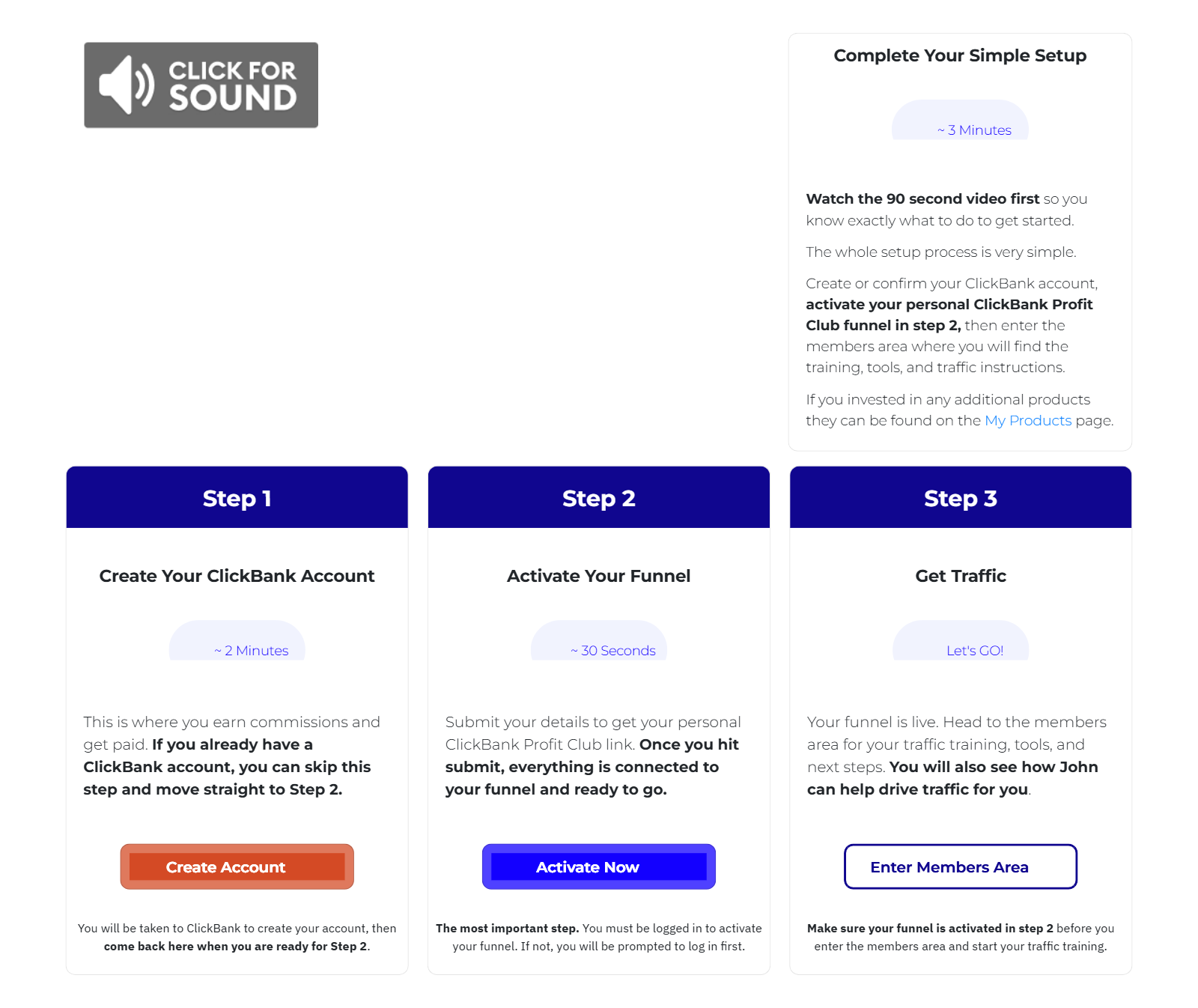
Want to know exactly what’s free and what’s locked? Read Is CB Profit Club free?
Step 5: Create your first 10 pieces of content
Not all content sells. These four types are the ones that bring affiliate sales, because the reader is already close to a decision:
- Reviews: “[Product] review: is it worth it?” The reader is deciding whether to buy.
- Comparisons: “[Product A] vs [Product B].” The reader has narrowed it down to two.
- “Best X for Y” lists: “Best email tools for beginners.” The reader is choosing.
- Tutorials: “How to [do something] with [product].” The reader needs a tool to finish the job.
A practical first batch of ten: three tutorials, three reviews, two comparisons and two “best of” lists, all in your one niche. Each piece should solve the reader’s problem first and recommend the product second. Content that only exists to push a link doesn’t rank, doesn’t get shared and doesn’t convert.
Whatever the format, put a reason to join your email list in every piece, such as “get my free checklist.” That’s how your content feeds the system you built in Step 4.
Step 6: Disclose, track and improve
Disclose every affiliate link. The FTC requires you to make your financial relationship clear, close to the recommendation. “I earn a commission if you buy through my links” works. A note hidden in a footer doesn’t. On video, say it out loud and put it in the description.
Track three numbers weekly: how many people saw your content, how many clicked your link, and how many bought or signed up. Your affiliate dashboard shows clicks and sales. Your channel’s analytics show views. A link shortener with click stats shows which piece of content sent each click.
Improve one thing at a time. Plenty of views but no clicks means your recommendation isn’t clear enough. Plenty of clicks but no sales usually means the product or the audience isn’t the right fit. Change one thing, wait a week, and compare.
Your first 90 days, week by week
| When | Focus | Done when |
|---|---|---|
| Week 1 | Choose your niche, join one or two programs, open a free Systeme.io account | You have your affiliate link and a login |
| Week 2 | Build your landing page, freebie and a 5-email sequence (or activate a done-for-you funnel) | A test sign-up receives every email |
| Weeks 3–4 | Publish your first 4 pieces of content on your one channel | 4 pieces live, each with a disclosed link and an email sign-up offer |
| Weeks 5–8 | Publish 2 pieces a week; read your analytics every Friday | 12 pieces live; you know which ones get clicks |
| Weeks 9–12 | Make more of what worked, update what didn’t, email your list weekly | A clear picture of your first clicks, sign-ups and sales |
At the end of 90 days, judge the trend, not the total. Rising views, clicks and sign-ups mean the system is working and needs more content. Flat numbers across all three usually mean the channel or the niche needs to change.
Whether your first sale comes inside these three months depends heavily on the channel. Short-form video and an existing audience are the fastest; search traffic is the slowest to start and the longest-lasting.
7 beginner mistakes to avoid
- Buying a course before trying anything. Learn the basics free, start, and pay for training only when you know what you’re stuck on.
- Joining ten programs. Focus beats variety at the start.
- Posting raw affiliate links on social media. They look like spam, many platforms limit them, and you don’t capture the visitor. Send people to your landing page instead.
- Promoting products you haven’t checked. Refunds take back your commission, and bad recommendations cost you your audience’s trust.
- Chasing every new platform. One channel, done consistently, beats five done occasionally.
- Skipping the email list. Without it, every visitor who doesn’t buy right away is gone.
- Quitting at week six. Most channels take months to build. The people who earn are mostly the ones who kept publishing.
The bottom line
Starting affiliate marketing as a beginner doesn’t take money, a website or an audience. It takes a sensible niche, one free program with no approval barrier, one traffic channel, a free email capture setup, and three months of steady content.
Do the six steps in order, follow the 90-day plan, and judge your results on the trend rather than week-to-week sales.
Ready to choose your first program? Compare commissions, cookie windows and approval rules in the 10 best affiliate programs for beginners.
FAQ
Can I start affiliate marketing with no money?
Yes. ClickBank, Digistore24 and Systeme.io’s affiliate program are free to join. Systeme.io’s free plan gives you landing pages, a blog and one automated email sequence for up to 2,000 contacts, and Kit’s free plan holds up to 10,000 subscribers. Your main investment is time.
Do I need a website to start affiliate marketing?
No. You can send traffic from YouTube, short videos or social posts to a free landing page and email sequence. A website helps later, especially for Google traffic, and Amazon Associates requires one, but many programs don’t.
How much does it cost to start affiliate marketing?
It can cost $0 using free plans. The first optional costs are usually a domain name (around $10 to $20 a year) and, once your list grows, an email tool plan such as Systeme.io’s $17-a-month Startup plan.
How long does it take to learn affiliate marketing?
You can learn the basics in a few days. Getting good at bringing traffic takes months of practice in one channel. Plan on at least 90 days of steady work before judging your results.
Can I do affiliate marketing with just my phone?
Yes. You can join programs, build a Systeme.io landing page, record short videos and post content from a phone. A laptop makes writing long articles and editing longer videos easier, but it isn’t required to start.
Can I start affiliate marketing under 18?
Most networks require you to be 18 or older. ClickBank’s terms state it directly, and payouts need a bank account in your name. Under-18s can learn the skills and build content, but need to wait or involve a parent according to each program’s rules.
How many affiliate programs should a beginner join?
One or two. Focusing on one offer helps you learn what makes people click and buy. Add more once your first one is bringing sales.
Is affiliate marketing hard for beginners?
The mechanics are easy: joining programs and getting links takes minutes. The hard part is consistently creating content that brings the right people. It’s simple, but it isn’t quick.