 Skip to content
Make Money Online · Moms
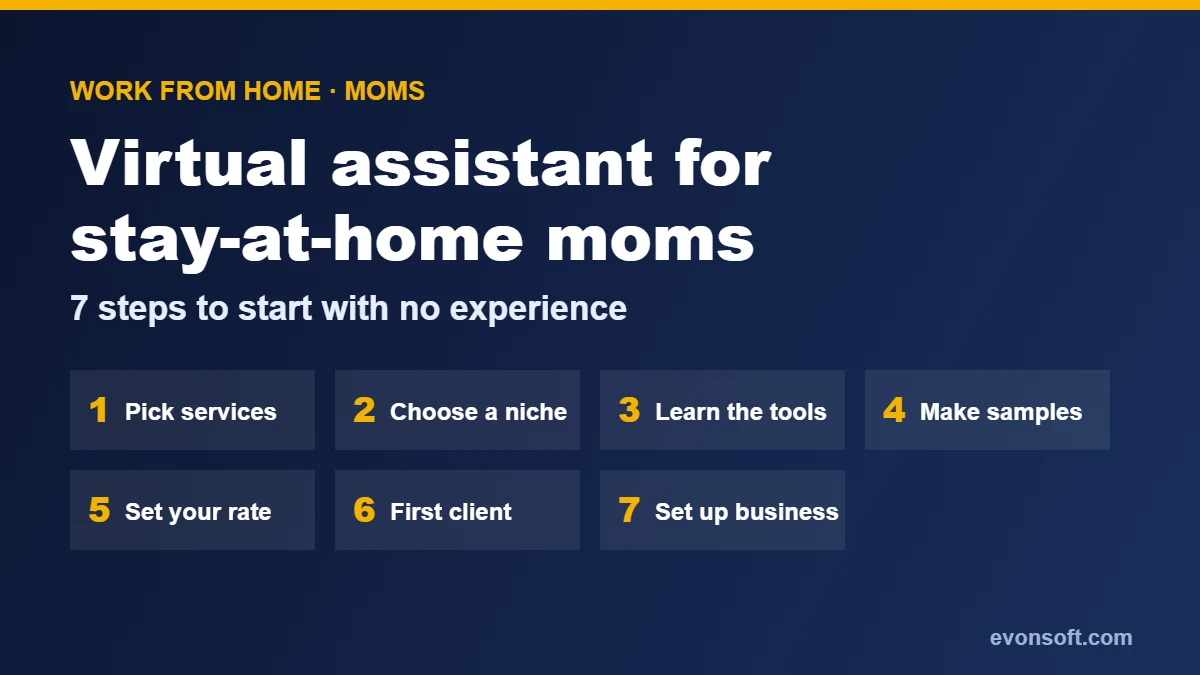
Becoming a virtual assistant for stay-at-home moms is one of the most practical ways to earn from home: you use skills you already have (organizing, writing, scheduling, keeping track of a hundred things at once) and you can start with no degree and almost no money. The catch is that most guides make it sound like $4,000 in your first month. For most moms, the first client takes a few weeks and the first few months are about building up hours and rates.
This guide covers what virtual assistants actually do, what they earn, the seven steps to start with no experience, where to find virtual assistant jobs for stay-at-home moms, how to avoid the scams that target moms, and how to fit client work around kids. For other work-from-home options, see our guide to making money as a stay-at-home mom.
What’s in this guide
- What a virtual assistant does
- How much virtual assistants earn
- Pros and cons: virtual assistant for stay-at-home moms
- How to become a virtual assistant with no experience
- Where to find virtual assistant jobs for stay-at-home moms
- VA job scams to avoid
- How to make VA work fit around kids
- How to earn more than an hourly rate
- FAQ
What a virtual assistant does
A virtual assistant handles tasks that a business owner doesn’t have time for, from home, usually as a freelancer or contractor rather than an employee. Small business owners, coaches, real estate agents, online shops and content creators are the most common clients. Most VAs start with general admin and then specialize, because specialists charge more.
| Type of VA | Typical tasks | Good fit if you… |
|---|---|---|
| Admin VA | Email inbox, calendar, booking calls, data entry, travel, documents | Are organized and run your household like a small company |
| Social media VA | Scheduling posts, Canva graphics, captions, replying to comments | Already enjoy Instagram, TikTok or Pinterest |
| Customer support VA | Answering emails and chats, order issues, refunds | Are patient and write clearly |
| Bookkeeping VA | Invoices, expenses, reconciling accounts in QuickBooks or Xero | Like numbers and detail (training needed) |
| Real estate VA | Listings, transaction paperwork, follow-ups with buyers | Want steady clients in one industry |
| Online business VA | Email newsletters, course platforms, funnels, product uploads | Like learning software |
How much virtual assistants earn
Pay depends on what you do, who you work for and how you charge. Upwork’s virtual assistant cost page lists median hourly rates of $10 to $20 on its platform, and says freelance VAs there charge an average of $18 to $35 an hour depending on skills and experience. Keep in mind that Upwork’s rates include VAs from countries with much lower living costs, so US-based VAs who specialize often charge more.
- Starting out: expect the lower end while you build reviews and samples.
- Specialized skills (bookkeeping, email marketing, funnel setup, real estate transactions) earn noticeably more than general admin.
- Monthly retainers (for example, 10 hours a month for a set fee) give you predictable income and are how most experienced VAs work.
As a quick example, 10 hours a week at $20 an hour is about $800 a month, before taxes and platform fees. That’s a realistic early goal for a mom working during naps and evenings.
Pros and cons: virtual assistant for stay-at-home moms
Why it works: it costs almost nothing to start, most tasks can be done whenever you have time, you can begin with skills you already have, and you can grow from one client to several at your own pace.
What’s hard: some clients expect quick replies or live calls during the day, the first client takes effort to find, and income stops when you stop working. If you need income that doesn’t depend on your hours, pair VA work with something you build once, like the ideas in our side hustle ideas guide.
How to become a virtual assistant with no experience
1. Pick one to three services
Don’t offer “everything.” List what you already do well (scheduling, organizing, writing, social media, spreadsheets, customer service from an old job) and turn it into one to three clear services, such as “inbox and calendar management for real estate agents.”
2. Choose who you want to help
A niche makes you easier to hire. If you worked in healthcare, education, retail or an office before kids, businesses in that field will trust you faster. A clear niche also tells you which tools to learn.
3. Learn the tools clients use
Most VA work happens in a handful of tools, and many have free plans or free training: Google Workspace (Gmail, Calendar, Docs, Sheets), Canva, a project tool like Trello or Asana, a scheduler like Calendly, and the email or social media tools your niche uses. Free tutorials from the tool makers themselves are enough to start.
4. Make three work samples
With no experience, samples are your proof. Create a sample social media calendar, a cleaned-up inbox system, a formatted spreadsheet or a short email newsletter. Put them in a simple Google Drive folder or a free portfolio page.
5. Set your rate and packages
Start with an hourly rate you’re comfortable with, then move to packages (for example, “10 hours a month”) once you’ve proven yourself. Raise your rate with each new client rather than waiting for a perfect moment.
6. Find your first client
Your first client usually comes from people you know: tell friends, former coworkers and local business owners exactly what you offer. At the same time, apply on the job sites below and in mom-focused job groups.
7. Set up the business side
Use a simple written agreement that covers your tasks, hours, rate, payment dates and how to end the work. Get paid through an invoicing tool or the platform you found the client on. In the US, VA income is usually self-employment income, and you generally owe self-employment tax once net earnings reach $400 a year; the Taxpayer Advocate Service has a plain-English guide to self-employment taxes.
Where to find virtual assistant jobs for stay-at-home moms
- Your own network: the fastest route to a first client, and they come with built-in trust.
- The Mom Project: a job site focused on connecting mothers with flexible and remote roles.
- Hire My Mom: a US job board where businesses post remote roles, including many VA positions.
- Upwork and Fiverr: large freelance marketplaces. Competition is strong and both take a fee from your earnings, but they’re good places to build first reviews.
- LinkedIn and Indeed: search “virtual assistant,” “remote executive assistant” and “remote admin.”
- VA agencies: companies such as Belay and Time Etc recruit freelance VAs; check each one’s current requirements, since many ask for previous admin experience.
- Facebook groups: VA and work-from-home mom groups often share job leads, but check every post carefully (see scams below).
VA job scams to avoid
Work-from-home moms are a favorite target for job scams. The FTC explains how to spot job scams, and the warning signs for VA work are consistent:
- They ask you to pay first: for training, “certification,” software or a starter kit to get the job.
- They send you a check: and ask you to buy equipment or gift cards and send back the difference. The check bounces and you lose the money.
- The pay is too good: high pay for simple tasks like “liking posts” or “reshipping packages.”
- Interviews only by text or chat app: with no video call, no company website and no written agreement.
How to make VA work fit around kids
- Choose tasks you can do anytime: inbox management, social media scheduling and bookkeeping can mostly be done during naps, school hours or evenings.
- Set clear hours with clients: tell them when you respond (for example, within 24 hours on weekdays) so you’re not glued to your phone.
- Book calls in protected time: school hours, a partner’s day off or a regular sitter slot.
- Use time zones: clients a few hours ahead or behind can make evening work feel like their morning.
- Start small: one client for 5 to 10 hours a week is plenty while you learn.
For more ideas that suit life with kids, see our guide to side hustles for women.
How to earn more than an hourly rate
VA work is reliable, but your income is capped by your hours. Many VAs grow by specializing, raising rates and moving to monthly packages. Others add an online income stream they own, so they’re not trading every dollar for time.
Affiliate marketing is the stream that fits best alongside VA work, because it doesn’t need fixed hours and you can build it slowly. If you want to start without building a website or funnel yourself, CB Profit Club is the done-for-you option we’ve looked at most closely:
- Join free on the Team tier, with no card required.
- Get a ready-made funnel tagged with your affiliate ID and a pre-written email campaign.
- Connect a free ClickBank account and an email autoresponder using ten short setup videos.
- Earn 50% on upgrade sales on the free tier. The optional VIP upgrade ($495 a year or $67 a month, with a 14-day guarantee) raises your commission rates.
FAQ
Can a stay-at-home mom be a virtual assistant with no experience?
Yes. Many VAs start with skills from running a household or an old job: organizing, scheduling, writing and customer service. Pick one to three services, learn the tools your clients use and make a few work samples to show instead of a résumé.
How much does a virtual assistant make?
Upwork lists median virtual assistant rates of $10 to $20 an hour, and says VAs there average $18 to $35 an hour depending on skills. Specialized US-based VAs on monthly packages often earn more.
Where can stay-at-home moms find virtual assistant jobs?
Start with your own network, then try The Mom Project, Hire My Mom, Upwork, Fiverr, LinkedIn, Indeed and VA agencies such as Belay and Time Etc. Mom-focused Facebook groups share leads too, but check every post for scams.
Do I need a degree or certification to be a virtual assistant?
No. Clients care about reliability and results. Free tool tutorials and a few work samples are enough to start. Be wary of anyone who says you must buy a certificate before they’ll hire you.
Can I be a virtual assistant part time?
Yes. Many moms start with one client for 5 to 10 hours a week and choose tasks that can be done during naps, school hours or evenings.
Do virtual assistants pay taxes?
In the US, generally yes. VA income is usually self-employment income, and you generally owe self-employment tax once net earnings reach $400 a year. Set aside part of every payment.