 Skip to content
Make Money Online · YouTube
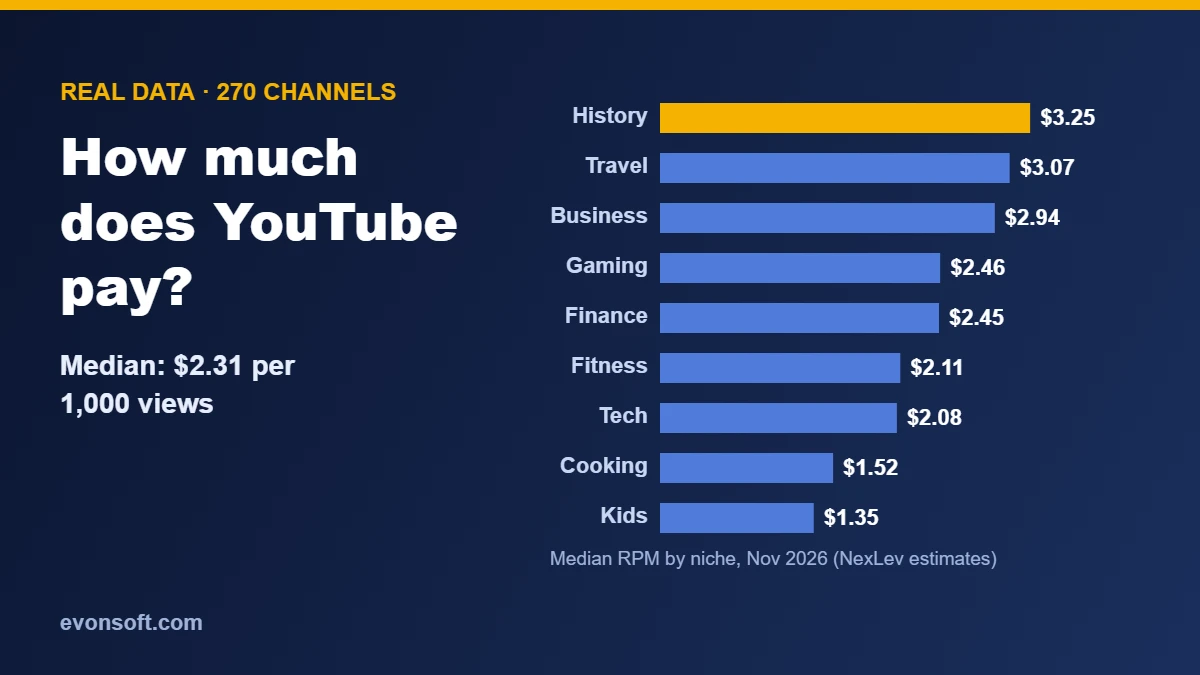
How much does YouTube pay? Most answers quote a range like “$3 to $5 per 1,000 views” and move on. We wanted real numbers, so we pulled estimated earnings for 270 monetized English-language channels with 10,000+ subscribers across nine popular niches, using the YouTube analytics tool NexLev. The typical channel earned about $2.31 per 1,000 views from ads, which is lower than most guides suggest.
Below you’ll find what YouTube pays per view, per 1,000 views and per million views, how much channels of different sizes earn each month, which niches pay best, what changes for Shorts and new channels on February 1, 2027, and how creators earn far more than ad revenue alone. If you’re new to earning online, our guide to affiliate marketing for beginners pairs well with this one.
What’s in this guide
- How YouTube pays creators
- How much does YouTube pay per view?
- How much does YouTube pay for 1 million views?
- How much can you make on YouTube by subscriber count?
- How much YouTube pays by niche
- How much YouTube Shorts pay
- What changes on February 1, 2027
- How to qualify for YouTube pay
- What raises or lowers your pay
- How to make more than ad revenue
- FAQ
How YouTube pays creators
YouTube doesn’t pay for views directly. It pays a share of the money advertisers spend on your videos, plus a share of YouTube Premium subscription revenue, once you’re in the YouTube Partner Program (YPP). According to YouTube’s own creator economy page, creators earn 55% of the revenue from ads shown on their long-form videos. For Shorts, YouTube pools ad revenue from the Shorts feed, and its Shorts monetization policy says creators keep 45% of their allocated revenue.
Two numbers explain what you’ll actually see in YouTube Studio:
- CPM (cost per mille): what advertisers pay per 1,000 ad impressions, before YouTube’s share. This is the bigger number people quote, and it’s not what you earn.
- RPM (revenue per mille): what you earn per 1,000 views after YouTube’s share, counting every view, including views that showed no ad. RPM is the honest number, and it’s the one we use throughout this guide.
How much does YouTube pay per view?
In our sample, the median channel earned an estimated $0.0023 per view, or $2.31 per 1,000 views. Most channels fell between $0.001 and $0.005 per view. Here’s what that means at different view counts:
| Views | Low RPM ($1.05) | Typical RPM ($2.31) | High RPM ($5.38) |
|---|---|---|---|
| 1,000 | $1 | $2.31 | $5.38 |
| 10,000 | $10.50 | $23 | $54 |
| 100,000 | $105 | $231 | $538 |
| 1,000,000 | $1,050 | $2,310 | $5,380 |
| 10,000,000 | $10,500 | $23,100 | $53,800 |
“Low” and “high” are the 10th and 90th percentiles of our 270 channels, so 8 in 10 channels sat between them. The highest estimated RPM in the sample was $10.60.
How much does YouTube pay for 1 million views?
At the median RPM in our data, 1 million views pays about $2,310. A channel in a low-paying niche, or one with mostly Shorts or non-US views, might earn closer to $1,000. One in a high-paying niche with long videos and a US audience can earn $5,000 or more.
The same logic answers the smaller questions people search for: 100,000 views pays roughly $105 to $538, and 10,000 views roughly $10 to $54. To earn $10,000 a month from ads alone at the median RPM, you’d need about 4.3 million views a month.
How much can you make on YouTube by subscriber count?
YouTube doesn’t pay per subscriber. Subscribers matter because they bring views. Here’s the median estimated monthly ad revenue for the channels in our sample, grouped by size:
| Subscribers | Channels | Median monthly ad revenue | Middle half earned | Median monthly views |
|---|---|---|---|---|
| 10,000–50,000 | 114 | $211 | $62–$713 | 96,000 |
| 50,000–100,000 | 54 | $519 | $86–$1,776 | 271,000 |
| 100,000–500,000 | 85 | $1,211 | $487–$3,585 | 596,000 |
| 500,000–1,000,000 | 11 | $3,360 | $433–$5,654 | 1.9 million |
The spread is huge. A channel with 100,000 subscribers that stopped uploading can earn less than a 30,000-subscriber channel posting every week, because pay follows recent views, not subscriber count. (Our sample had only six channels above 1 million subscribers, too few to give a reliable figure.)
How much YouTube pays by niche
The topic of your channel decides which advertisers bid on your videos. Here’s the median estimated RPM for each of our nine niches, with the middle half of channels in brackets:
| Niche | Median RPM | Middle half | Median monthly ad revenue |
|---|---|---|---|
| History and documentary | $3.25 | $2.60–$5.03 | $1,420 |
| Travel | $3.07 | $2.37–$4.15 | $992 |
| Business and making money online | $2.94 | $1.90–$4.91 | $331 |
| Gaming | $2.46 | $1.75–$2.75 | $786 |
| Personal finance and investing | $2.45 | $2.07–$4.65 | $558 |
| Fitness and health | $2.11 | $1.57–$3.01 | $482 |
| Tech reviews | $2.08 | $1.37–$2.59 | $609 |
| Cooking | $1.52 | $0.96–$1.89 | $311 |
| Kids and nursery rhymes | $1.35 | $0.84–$2.14 | $149 |
Two things stand out. First, finance and business channels have the widest range: the best-paid quarter earn $4.65 to $4.91 or more per 1,000 views, but many smaller channels with global audiences earn much less than the “$10+ finance RPM” figures you’ll see quoted. Second, history and documentary channels did best overall, helped by long videos that fit more ads. That’s one reason faceless documentary channels are popular; our guide to making money on YouTube without making videos covers how they work.
Kids’ content pays least because videos made for kids can’t show personalized ads, which advertisers pay less for.
The tool and course behind this data
Every RPM and revenue figure on this page came from NexLev, a YouTube research tool built for faceless channels. NexLev says it tracks more than 50,000 channels with estimated revenue, RPM, upload frequency and growth scores, so you can see what a niche actually pays before you spend months on it. It includes:
- Niche Finder: search channels by topic and filter by RPM, monthly revenue, subscribers and channel age to spot niches where new channels are growing fast.
- Chrome extension: see a channel’s estimated earnings and RPM while you browse YouTube.
- YouTube Faceless Course: step-by-step training on starting and growing a faceless channel.
If you’re serious about building a channel that earns, checking a niche’s real RPM first is the cheapest mistake you’ll ever avoid.
How much YouTube Shorts pay
Shorts are paid differently from long-form videos. YouTube pools the ad revenue earned between videos in the Shorts feed, sets aside part of it to cover music licensing, then splits the rest among creators based on their share of Shorts views. You keep 45% of what’s allocated to you. Because ads run between Shorts rather than inside them, Shorts usually earn far less per view than long-form videos, which is why many channels use Shorts to win subscribers and long-form videos to earn.
What changes on February 1, 2027
In August 2026, YouTube announced the first big changes to the YouTube Partner Program since 2018. They take effect on February 1, 2027:
- Higher entry bar for new channels: creators applying to YPP for ads and Premium revenue will need 8,000 qualified watch hours in the last 365 days, or 20 million qualified Shorts views in the last 90 days. Channels already in YPP aren’t affected, and the thresholds for fan funding and shopping features stay the same.
- Shorts revenue needs 10 million views: channels will earn Shorts ad and subscription revenue only while they have 10 million qualified Shorts views over the last 90 days. Channels below that stay in YPP and keep earning on long-form videos.
- Premium Lite everywhere: YouTube is expanding Premium Lite to every country with YouTube Premium. Creators still receive 55% for long-form and 45% for Shorts from the subscription pool.
- New bonuses: YouTube says it will add incentive programs, such as bonuses for YouTube Shopping, brand deals and growth milestones, for channels below the Shorts threshold.
If you’re starting a channel now, the practical takeaway is simple: plan for long-form videos and income beyond ads from day one. Existing YPP members need to accept the new terms in YouTube Studio by January 31, 2027.
How to qualify for YouTube pay
YouTube’s YPP eligibility page lists two levels. Until the 2027 changes above take effect:
- Fan funding and shopping: 500 subscribers, plus 3 public uploads in the last 90 days and either 3,000 watch hours in the last 12 months or 3 million Shorts views in the last 90 days. This unlocks channel memberships, Super Thanks and YouTube Shopping, but not ad revenue.
- Ad revenue: 1,000 subscribers with either 4,000 watch hours in the last 12 months or 10 million Shorts views in the last 90 days.
You also need to follow YouTube’s monetization policies, live in a country where YPP is available and have a linked AdSense account. Channels that mass-produce repetitive or low-effort videos risk being refused, which matters if you plan to use AI tools.
What raises or lowers your pay
- Niche: topics that attract advertisers with something expensive to sell (finance, software, business, travel) pay more than entertainment aimed at kids.
- Audience country: advertisers pay much more to reach viewers in the US, Canada, the UK and Australia than in most other countries.
- Video length: videos of 8 minutes or longer can show mid-roll ads, so a 15-minute video can earn several times more per view than a 4-minute one.
- Season: ad prices usually rise toward the holidays in Q4 and dip in January.
- Shorts share: a channel whose views are mostly Shorts will have a much lower overall RPM.
- Ad blockers and Premium: views without ads earn nothing from ads, though Premium viewers add subscription revenue.
How to make more than ad revenue
For most channels, ads are the smallest income stream. A video with 10,000 views might earn $23 from ads, but one affiliate sale or a single sponsor mention can pay more than that. Here’s how creators stack income:
- Affiliate links: recommend products in your videos and descriptions and earn a commission on each sale. This works from your very first video, long before you qualify for YPP.
- Sponsorships: brands pay for mentions, often from a few thousand subscribers in a focused niche.
- Your own products: templates, courses, coaching or a paid community. See our list of passive income ideas for options that keep paying.
- Fan funding: memberships, Super Thanks and Super Chat from 500 subscribers.
- YouTube Shopping: tag products in your videos and earn from sales.
Affiliate marketing is the easiest of these to add to any channel. If you don’t have your own product yet, CB Profit Club gives you a ready-made funnel you can link from your video descriptions:
- Join free on the Team tier, with no card required.
- Get a done-for-you funnel tagged with your affiliate ID and a pre-written email campaign, so viewers who click join your email list.
- Connect a free ClickBank account and an email autoresponder using ten short setup videos.
- Earn 50% on upgrade sales on the free tier. The optional VIP upgrade ($495 a year or $67 a month, with a 14-day guarantee) raises your commission rates.
Not sure YouTube is right for you? Compare it with other options in our list of 30 side hustle ideas, or see how short-form works on another platform in our guide to making money on TikTok without followers.
FAQ
How much does YouTube pay per 1,000 views?
In our sample of 270 monetized channels, the median was about $2.31 per 1,000 views, with most channels between $1.05 and $5.38. Long videos, high-paying niches and US audiences earn more.
How much does YouTube pay for 1 million views?
Roughly $1,000 to $5,400, with about $2,300 at the median RPM in our data. The exact amount depends on your niche, video length and where your viewers live.
How much does YouTube pay for 100k views?
About $105 to $538, or around $231 at the median RPM in our data.
How much can you make on YouTube with 100k subscribers?
In our sample, channels with 100,000 to 500,000 subscribers earned a median of about $1,211 a month from ads, with the middle half between $487 and $3,585. Pay follows recent views, so an active channel earns much more than an inactive one of the same size.
Does YouTube pay for subscribers?
No. YouTube pays a share of ad and Premium revenue from your views. Subscribers help because they watch your new videos, but they don’t earn money on their own.
How many views do you need to make money on YouTube?
For ad revenue, you first need to join the YouTube Partner Program: currently 1,000 subscribers with 4,000 watch hours or 10 million Shorts views. New applicants from February 1, 2027 will need 8,000 watch hours or 20 million Shorts views. Affiliate links and sponsors can pay before that.
How much do YouTube Shorts pay?
Creators keep 45% of the Shorts revenue allocated to them, and Shorts usually earn far less per view than long-form videos. From February 1, 2027, channels need 10 million qualified Shorts views in the last 90 days to earn Shorts ad revenue.