 Skip to content
Affiliate Marketing · Honest Answer
Short answer: no, affiliate marketing is not a scam. It’s a legal, regulated way for companies like Amazon, Shopify and HubSpot to pay people a commission for sending them customers. The scams are the things sold around it: expensive coaching programs, “done-for-you” AI stores and fake “affiliate jobs” that promise easy income. The FTC has shut several of these down, with losses running into the hundreds of millions. Affiliate marketing itself is real, but most people earn little at first, which is why it so often feels like a scam.
If you’ve watched a few “make money online” videos, your doubt is reasonable. The same phrase, affiliate marketing, is used by Amazon to describe a program that has run for decades, and by schemes that charge $45,000 for a “business” that never makes a sale.
This article separates the two, with evidence rather than opinion: the FTC’s own enforcement cases, its test for telling a real business from a pyramid scheme, and real income figures from inside an affiliate program. I’ve worked as an affiliate for about six years on ClickBank, JVZoo, WarriorPlus and Digistore24, and I’ll be straight about what’s real, what’s hype, and when it isn’t worth your time.
If you already believe it’s legit and want to find a trustworthy program, my list of the best affiliate programs for beginners includes the commission, cookie and payout terms for each one.
In this article
- Why affiliate marketing is legitimate
- Why so many people think it’s a scam
- Real scams the FTC has shut down
- Affiliate marketing vs MLM vs pyramid schemes
- 5 affiliate-related scams to avoid
- How to check any program in 5 minutes
- Is affiliate marketing worth it in 2026?
- What real affiliate income looks like
- FAQ
Why affiliate marketing is legitimate
Three facts settle whether the model itself is legitimate:
- Large, well-known companies run affiliate programs openly. Amazon Associates, Shopify, HubSpot, Kinsta and WP Engine all publish their commission rates and terms. Companies like these don’t pay people commissions unless it brings them customers.
- It’s regulated like any other advertising. In the US, the FTC requires affiliates to disclose that they earn commissions, clearly and close to the link. Regulators don’t write disclosure rules for activities they consider fraud.
- It’s taxed like any other income. US programs report what they pay affiliates on Form 1099, and affiliates outside the US complete tax forms such as the W-8BEN when they sign up.
The mechanism is also simple and transparent. A customer clicks your tracked link, buys at the normal price, and the company pays you a share of the sale. The customer pays nothing extra, and nobody has to recruit anyone. I explain the full process, including when and how you get paid, in how you make money with affiliate marketing.
Why so many people think it’s a scam
The doubt doesn’t come from nowhere. Four things give affiliate marketing a bad reputation:
- Scams borrow the name. Programs that sell expensive coaching or “business in a box” packages often call themselves affiliate marketing, because the real thing has a respectable reputation. When they collapse, the whole industry takes the blame.
- Income screenshots are survivorship bias. You see the person who made $10,000 last month, not the hundreds who made nothing. Even honest screenshots show the best result, not the typical one.
- Some programs pay you to recruit other affiliates. When the main way to earn is signing up the next person, it looks and feels like an MLM, and sometimes that’s exactly what it is.
- Most beginners earn very little at first. Affiliate income depends on traffic, and building traffic takes months. Someone who quits after six weeks with $0 can easily conclude it was a scam, when really it was just slow.
Real scams the FTC has shut down
Here’s what genuine money-making scams look like, from the FTC’s own case announcements. None of these was an ordinary affiliate program. They were coaching and “business opportunity” schemes that used the same language: passive income, done-for-you systems, AI.
| Scheme | What it promised | What it cost people |
|---|---|---|
| MOBE (“My Online Business Education”) | “Easy, fast money online” and six figures a year. In 2020 the FTC also went after five of its top affiliates for luring people in with free or cheap videos. | Over $300 million in total losses; upsells of $2,000 to $30,000 for “worthless membership upgrades and mentoring services” |
| Click Profit (FTC action, March 2025) | AI-powered online stores and “passive income,” with claimed links to brands like Nike and Disney | At least $14 million; a minimum $45,000 “management fee.” Amazon suspended about 95% of its stores. |
| Ascend Ecom (order, June 2025) | “Cutting edge” AI tools to “quickly earn thousands of dollars a month in passive income” | At least $25 million; owners banned from selling business opportunities |
| FBA Machine / Passive Scaling (settlement, July 2025) | Online storefronts run by “AI-powered software” with guaranteed income | Over $15 million; owner permanently banned from selling business opportunities |
The pattern is the same every time: a low-cost or free entry point, big income promises, and then an expensive package. As the FTC puts it, “the promise of quick and easy money is always a lie, and a sign of a scam.”
Notice what’s missing from every case: none of them was “join a company’s affiliate program for free and earn a commission when someone buys.” That model, the real one, doesn’t require you to hand over money.
Affiliate marketing vs MLM vs pyramid schemes
The FTC draws the line on one question: where does the money come from? In a legitimate MLM, it says, you’re paid “based on your sales to retail customers, without having to recruit new distributors.” In a pyramid scheme, “your income would be based mostly on how many people you recruit, not how much product you sell.”
| Affiliate marketing | MLM | Pyramid scheme | |
|---|---|---|---|
| Cost to join | Usually free | Starter kit or inventory | Often a large buy-in |
| You earn from | Customers who buy through your link | Your sales plus your recruits’ sales | Mostly recruiting new members |
| Must you buy products? | No | Usually expected | Yes, often to “qualify” |
| Recruiting required? | No | Encouraged | It’s the main income |
| Legal? | Yes, with disclosure | Yes, if income comes from retail sales | No |
Even legitimate MLMs are a poor bet for most people. The FTC states plainly: “Most people who join legitimate MLMs make little or no money. Some of them lose money.” A normal affiliate program has none of the buy-in or recruiting. If one starts to look like the right-hand column, walk away.
5 affiliate-related scams to avoid
- Pay-to-play coaching. A cheap course leads to a sales call and a package costing thousands, and you’re told you have to own the package to earn commissions on it. This is the MOBE model. I cover it in detail in high-ticket affiliate marketing, because that’s where it hides most often.
- “Done-for-you” AI stores and businesses. You pay a large fee and someone else supposedly runs a profitable store or system for you. The Click Profit, Ascend Ecom and FBA Machine cases above all fit this pattern.
- Fake “affiliate marketing jobs.” Real affiliate programs don’t hire you or charge you a fee to start. If a “job” asks you to pay for training, a starter kit or an “activation,” it’s a scam.
- Programs that never pay. Some small, unknown programs collect sales and then find reasons not to pay affiliates. Stick to programs run by known brands or established networks, with public payout terms.
- Courses sold on income screenshots. When the main proof is a dashboard screenshot rather than what you’ll actually learn, the course usually makes its real money from selling the course. The FTC specifically warns about “success stories and testimonials” that “might not be true or typical.”
How to check any affiliate program in 5 minutes
Run any program, course or “opportunity” through these seven questions before you sign up or pay:
- Is it free to join? Most legitimate affiliate programs are. A required fee to start earning is the biggest red flag.
- Do you earn from customers or from recruits? If most of the money comes from signing up new people, it’s the pyramid pattern.
- Are the terms public? Look for the commission rate, cookie window, payout minimum and payment method in writing.
- Who processes payments? A known brand, or an established network like ClickBank, Digistore24, Impact or PartnerStack, is far safer than an unknown site paying you directly.
- What do others say? The FTC’s own advice is to search the company’s name with words like “scam” or “complaint” before you pay.
- Are income claims typical, or the best case? Guaranteed income, “proven systems” and made-up returns are on the FTC’s list of warning signs.
- Is anyone pressuring you to decide now? Pressure to act today, or to pay more to “help your business succeed,” is a reason to stop.
The one-line test: if you can’t earn a commission without paying first, or your income depends on recruiting the next person, it isn’t affiliate marketing in any sense that matters. Walk away.
Is affiliate marketing worth it in 2026?
It’s legitimate. Whether it’s worth it depends on you. Here’s the honest trade-off:
| Why it’s worth it | Why it might not be |
|---|---|
| Free or very cheap to start | Income usually takes months to arrive |
| No product, inventory, shipping or customer support | You don’t control the product, prices or commission rates |
| Recurring commissions can stack up into steady income | Programs can cut rates or close without much notice |
| Content and email lists keep earning after you build them | Popular niches are crowded |
| Works with writing, video or email; no face required | Search and social platforms change their rules |
Is it dead or oversaturated? No, but it has changed. Google now answers many simple questions directly. When I checked the search results for this article’s keywords, every one showed an AI-generated overview at the top. That makes thin, generic affiliate content much harder to rank. What still works is the kind of content an AI summary can’t replace: first-hand reviews, real comparisons, honest pros and cons, and email lists you own.
It’s worth it if you’re willing to put in 5 to 10 hours a week for at least three months before judging results, to learn one traffic channel properly, and to recommend products you’d stand behind.
It isn’t worth it if you need income within the next few weeks, aren’t willing to create content, or are being asked to pay thousands up front for a “system.” For a realistic start with free tools, follow my affiliate marketing for beginners guide.
What real affiliate income looks like
Instead of a best-month screenshot, here’s a whole distribution. CB Profit Club, a ClickBank-based affiliate program I’m a member of, shows a live leaderboard of every member’s gross sales. When I checked in October 2026:
| Gross sales | #1 member | #10 member |
|---|---|---|
| Last 30 days | $3,631.15 | $816.28 |
| All time | $76,721.02 | $4,096.78 |
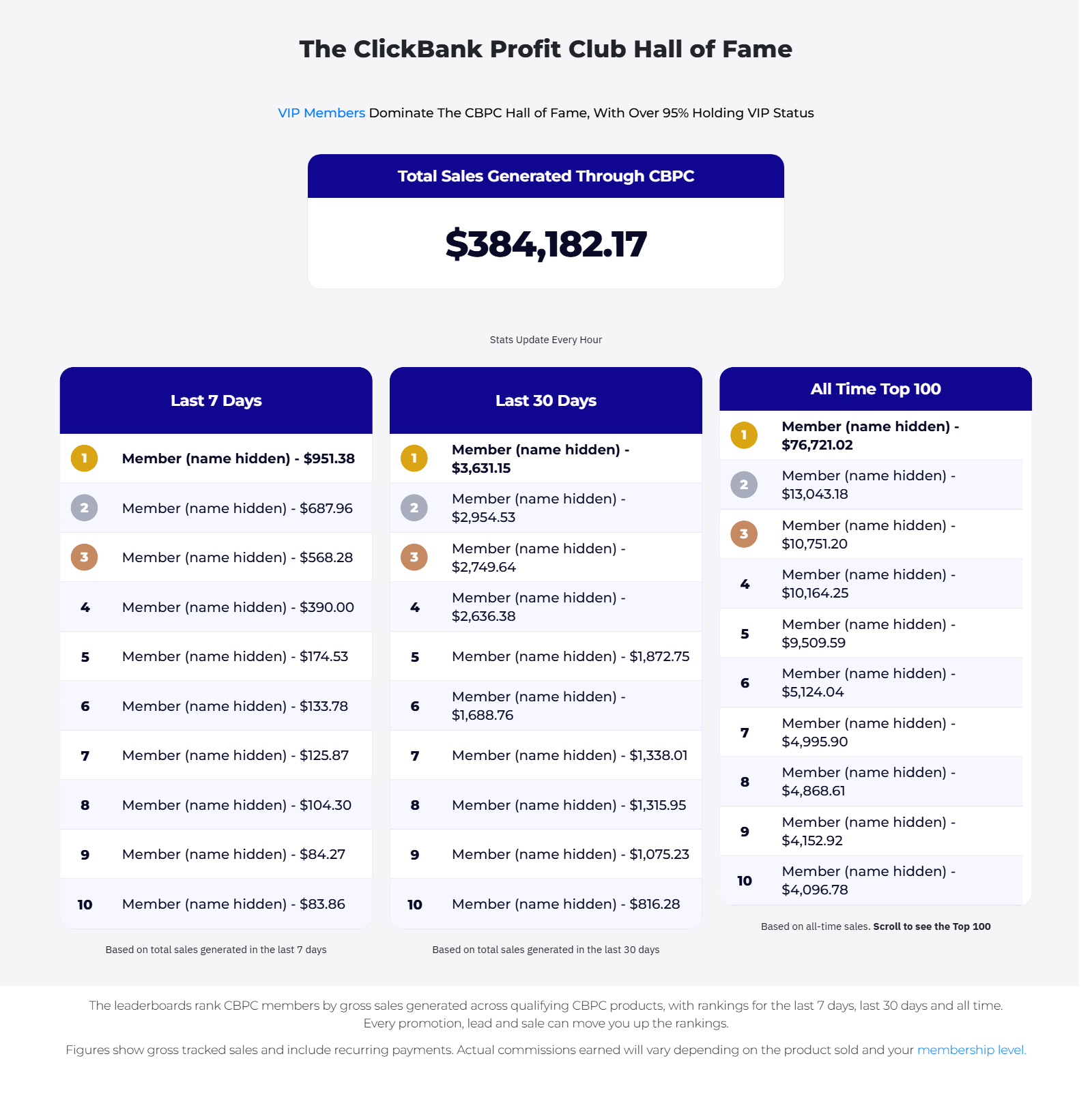
The 100th member all-time was at $393.24. The club’s total tracked sales were $384,182.17, while its sales page says over 16,914 members have joined. That’s roughly $23 in sales per member on average. The two figures were published at different times, so treat it as a rough guide, but the shape is clear.
That’s what honest affiliate income looks like: real money, paid through ClickBank, concentrated among a minority who built traffic, and little or nothing for most members. It isn’t a scam, and it isn’t easy money either.
Where CB Profit Club stands on the checklist
Since I recommend it, here’s the same 7-question test applied to it:
- It’s free to join, and the Team tier pays real commissions: 50% on upgrades.
- You earn when referred members buy upgrades, not just for recruiting them.
- The commission table is published inside the members area, and payments go through ClickBank.
- Paid upgrades have a 14-day money-back guarantee.
- The one thing to watch: the paid VIP tier ($495 a year) pays higher rates and adds traffic. That’s optional, and the free tier works without it.
For the full picture, including what’s locked on the free tier, read my CB Profit Club review.
The bottom line
Affiliate marketing is not a scam. It’s a regulated, taxed and widely used way for companies to pay for customers, and you can join the best programs for free. The scams are the coaching packages, done-for-you stores and fake jobs that borrow its name and its reputation.
Use the 7-question check on anything you consider. Never pay to be allowed to earn, and expect slow, real progress rather than fast, guaranteed money. If you do that, the only real risk is your time.
Ready to see which programs pass the test? Compare commissions, cookie windows and payout terms in the 10 best affiliate programs for beginners.
FAQ
Is affiliate marketing legit?
Yes. Companies like Amazon, Shopify and HubSpot run affiliate programs openly, the FTC regulates it with disclosure rules, and commissions are taxed like normal income. What isn’t legit are schemes that use the term to sell expensive coaching or “done-for-you” businesses.
Is affiliate marketing a pyramid scheme?
No. In affiliate marketing, you earn when customers buy through your link, and joining is usually free. The FTC defines a pyramid scheme as one where income comes mostly from recruiting people rather than from selling to customers. A program that pays you mainly for recruits is the warning sign.
Is affiliate marketing legal?
Yes. In the US, the main legal requirement is the FTC’s rule that you clearly disclose your financial relationship near your affiliate links. You also have to report affiliate income for tax.
Is affiliate marketing dead in 2026?
No, but it has changed. AI-generated answers at the top of Google make generic content harder to rank. First-hand reviews, honest comparisons, video and email lists still work well, and companies keep launching new affiliate programs.
Why is affiliate marketing so hard?
Because joining a program is easy, but building traffic isn’t. Getting the right people to see your recommendations takes months of consistent content in one channel. Most beginners quit before that happens.
Are affiliate marketing jobs legit?
Be careful. Affiliates are independent partners, not employees, and real programs never charge you to start. A “job” that asks you to pay for training, a kit or an activation fee is a scam. Legitimate companies do hire affiliate managers, but those are normal salaried roles.
Can you lose money with affiliate marketing?
With a legitimate program, your main risk is time, because joining is free. You can lose money if you pay for ads that don’t convert, buy expensive courses, or fall for pay-to-play schemes that charge thousands up front.
Is high-ticket affiliate marketing a scam?
The concept isn’t: companies like Kinsta and WP Engine openly pay $200 or more per referral. But “high-ticket” is where many pay-to-play schemes hide. If you must buy an expensive package before you can earn commissions, avoid it.