 Skip to content
Affiliate Marketing · Guide
Short answer: you make money with affiliate marketing by sharing a tracked link to someone else’s product. When a person clicks it and buys, the company pays you a commission, usually a percentage of the sale. You get paid on a schedule (weekly to monthly) once you pass a minimum payout, after any refund window. The hard part isn’t the link. It’s getting enough of the right people to click it.
Most guides on this question explain what affiliate marketing is, list a few “tips,” and stop. They skip the part beginners actually get stuck on: how a click turns into money in your bank account, how long that takes, and why most people earn very little in their first year.
This guide covers all of it: the mechanics, the five ways affiliates are paid, real payout rules from ClickBank and Amazon, taxes, and what realistic income looks like, using real leaderboard numbers rather than screenshots of someone’s best month. I’ve been promoting ClickBank, JVZoo, WarriorPlus and Digistore24 products for about six years, so this is written from the affiliate’s side of the table.
If you already understand the basics and just want to choose a program, skip to my list of the best affiliate programs for beginners.
In this guide
- How affiliate marketing works
- One sale, step by step
- The 5 ways affiliates get paid
- How the money reaches you
- Taxes on affiliate income
- Where the buyers come from
- How much can you realistically make?
- How long until your first commission?
- Can you do it without a website or followers?
- The rules you have to follow
- How to start this week
- FAQ
How affiliate marketing works
Every affiliate sale involves the same four parties:
| Who | What they do | What they get |
|---|---|---|
| The merchant (or vendor) | Owns the product and sets the commission | A sale they wouldn’t otherwise have made |
| You, the affiliate | Recommend the product with your tracked link | A commission on each sale you send |
| The network or tracking platform | Tracks clicks and sales, handles payments (ClickBank, Digistore24, JVZoo, Amazon’s own system) | A fee, usually paid by the merchant |
| The customer | Clicks your link and buys | The product, at the normal price |
Two things about this setup matter more than anything else.
The customer doesn’t pay extra. Your commission comes out of the merchant’s margin. That’s why merchants are happy to pay 50% or more on digital products: the extra copy costs them almost nothing to deliver, so half a sale is still profit.
You only earn when someone buys (or, on some programs, signs up). With almost every affiliate program, you aren’t paid for clicks, views or followers. A post with 10,000 views and no sales earns nothing. A small email list that buys earns a lot. That single fact explains why some affiliates with tiny audiences out-earn influencers.
One sale, step by step
Here’s exactly what happens between someone clicking your link and you getting paid:
- You get your link. When you join a program, you get a link with your ID built in, for example product.com/?ref=yourname or a ClickBank “hoplink”.
- Someone clicks it. The tracking system records the click and usually drops a cookie in their browser, tying any purchase back to you.
- They buy within the tracking window. Each program sets how long that click counts. On Amazon it’s 24 hours, extended to 89 days if they added the product to their cart in that time. Digistore24 uses 180 days. If they come back after the window closes, you get nothing.
- The commission is recorded. It shows in your dashboard, usually within minutes on digital networks.
- The refund window passes. If the customer gets a refund, your commission is taken back. Most digital products offer 30 to 60 days’ money-back, so a sale isn’t really “yours” until then.
- You reach the payout threshold. Programs only pay once your balance passes a minimum, such as $10 or $100.
- The payment is sent on the program’s schedule: weekly, every two weeks or monthly.
A worked example: you promote a $495-a-year membership upgrade that pays affiliates 50%. Someone clicks your link, joins, and upgrades three weeks later. You earn $247.50, which shows in your dashboard right away. It’s paid in the next pay period after it clears your network’s thresholds. Those are CB Profit Club’s real numbers on its free Team tier, which I cover in my CB Profit Club review.
The 5 ways affiliates get paid
“Commission” covers several different deals. Which one a program uses changes how much a single customer is worth to you:
| Model | How it pays | Typical in |
|---|---|---|
| Percentage of sale | A share of each order | Amazon (1% to 10% depending on category), ClickBank and Digistore24 products (often 50% or more) |
| Recurring | A share of every monthly or yearly payment while the customer stays | Software: Systeme.io pays 60% for life, ElevenLabs 22% for 12 months |
| Flat fee per sale | A fixed amount per new customer | Shopify (up to $150 per referral), hosting companies |
| Per lead | Paid when someone signs up or fills in a form, no purchase needed | Insurance, finance, free trials |
| Upsells and second tier | Commission on later upgrades, or on sales made by affiliates you referred | Funnels with upsells; GoHighLevel pays an extra 5% second tier |
For a beginner, recurring commissions are the ones to pay attention to. A one-time $30 commission has to be earned again every month. A $20-a-month recurring commission keeps paying while the customer stays, so each customer you add stacks on top of the last. That’s how small affiliate incomes grow without needing more traffic every month.
And to answer one of the most-searched questions directly: do affiliates get paid for clicks? Almost never. Pay-per-click affiliate deals exist, but they’re rare and low-paying. Plan on being paid for sales.
How the money actually reaches you
This is the part that catches beginners out. Your dashboard can show $60 in commissions while your bank account shows nothing, and that’s normal. Here’s how two of the biggest platforms handle it, straight from their official terms:
| ClickBank | Amazon Associates | |
|---|---|---|
| How often | Weekly or every two weeks, paid on Fridays | Monthly, about 60 days after the end of the month you earned it |
| Minimum payout | $100 by default (you can set it as low as $50) | $10 by direct deposit or gift card, $100 by check |
| Before your first payment | At least 5 sales | 3 sales within 180 days to keep the account |
| Fees | $5 per payment; $45 per wire transfer | $15 check processing fee |
| Payment methods | Direct deposit (including India, UK and Europe), wire, check. No PayPal. | Direct deposit, gift card, check |
Put together, a realistic timeline for a first Amazon commission earned in March is a payment in late May. On ClickBank, the money can arrive within a week or two of the sale, but only once you’ve made five sales and crossed your threshold.
Two practical tips:
- Set up direct deposit on day one. On ClickBank, the default payment method is a paper check, which is slow and costs the same $5 fee.
- Don’t count a commission until its refund window has passed. Refunds are a normal part of selling digital products, and your balance can go down as well as up.
Taxes on affiliate income
Affiliate commissions are taxable income. In the US, programs report what they pay you on Form 1099-NEC or 1099-MISC. Starting with payments made in 2026, a company only has to send you that form once it pays you at least $2,000 in a year, up from $600, after the One Big Beautiful Bill Act raised the threshold.
That doesn’t change what you owe. You still have to report all affiliate income on your tax return, including amounts below $2,000 where you never receive a form.
If you live outside the US, networks will ask you to complete a tax interview when you sign up, usually a W-8BEN form, and your income is taxed under your own country’s rules. I’m not a tax adviser, so check with one once your commissions become regular.
Where the buyers come from
Joining a program takes five minutes. The real work in affiliate marketing is getting the right people to your link, and there are only a handful of ways to do it:
| Traffic source | Cost | Speed | Does it last? |
|---|---|---|---|
| SEO (a blog or review site) | Low money, lots of time | Slow: new content usually takes months to rank | Yes. A ranking article can earn for years. |
| YouTube | Low money, lots of time | Slow to medium | Yes. Videos keep getting search views. |
| Email list | Autoresponder fee | Depends on how you build the list | Yes. You own the list. |
| Short-form social (TikTok, Reels, Pinterest) | Free | Fast when a post takes off | Mostly no. Posts fade within days, except on Pinterest. |
| Paid ads | Money up front | Fastest | Only while you pay. Easy to lose money while learning. |
Pick one and stay with it for at least three months. The most common reason beginners earn nothing is switching channels every few weeks, so none of them ever builds momentum.
Whatever the channel, the affiliates who earn steadily tend to do one thing the same way: they collect email addresses and follow up, rather than sending visitors straight to a sales page once. Most people don’t buy on their first visit. A follow-up email sequence gives them several more chances.
How much can you realistically make?
Affiliate income is three numbers multiplied together:
Income = visitors who click your link × percentage who buy × commission per sale
For illustration: 1,000 people a month click through to a $50 product, 2% of them buy, and you earn 50%. That’s 20 sales × $25 = $500 a month. Change any one number and the result changes a lot: 100 clicks gives you $50; a 1% conversion rate halves it.
The formula shows why beginners earn little at first. The commission rate is fixed when you choose a program. Traffic is what you build, and it starts at close to zero.
For a real-world check, here’s what the live “Hall of Fame” leaderboard inside CB Profit Club showed when I took this screenshot in October 2026:
| Gross sales | #1 member | #10 member |
|---|---|---|
| Last 30 days | $3,631.15 | $816.28 |
| All time | $76,721.02 | $4,096.78 |
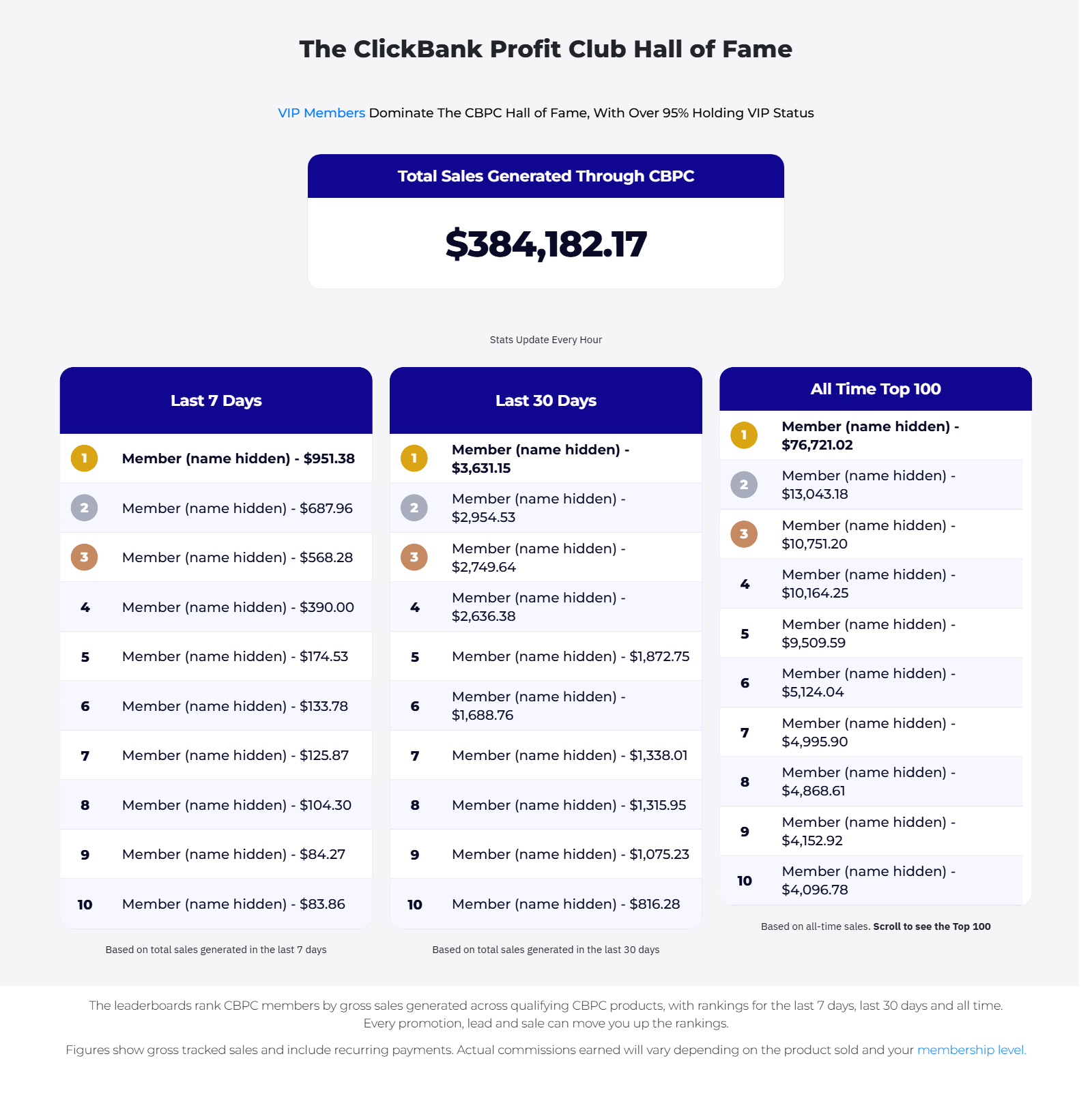
The number 100 member, all time, was at $393.24. These are real affiliates promoting a real product. A handful earn well, a top-ten month is a few hundred dollars in commissions, and most members earn little or nothing, because most members never build a traffic source.
That’s the honest picture of affiliate marketing in general, not just one program. The income is real and it can grow large, but it’s earned, and the first year is usually the slowest.
How long until your first commission?
It depends almost entirely on your traffic source:
- Paid ads: days. But you’ll usually spend more than you earn while you learn.
- Short-form social or an existing audience: weeks, if a post takes off or your followers trust you.
- Email: weeks to months, depending on how fast the list grows.
- SEO and YouTube: usually several months before you see steady sales, then the slowest to fade.
Then add the payment delay from the table above. A first commission landing in your bank account three to six months after you start is a normal result, not a failure.
Can you do it without a website or followers?
Yes. You need a way to reach people, but it doesn’t have to be your own website or a big following. You can send traffic to a ready-made funnel: a landing page that collects the visitor’s email, followed by an automatic email sequence that recommends the product over several days.
That’s the model CB Profit Club is built on. On its free Team tier, you get your own copy of a done-for-you funnel tagged with your ClickBank ID, plus a pre-written follow-up email campaign that imports into your autoresponder. You earn 50% on upgrades your referred members buy later. It’s a low-cost way to see the whole affiliate process working, from click to email to commission, before you build anything of your own.
The catch is the same one this whole guide keeps coming back to: the funnel doesn’t bring visitors. On the free tier, every visitor has to come from you.
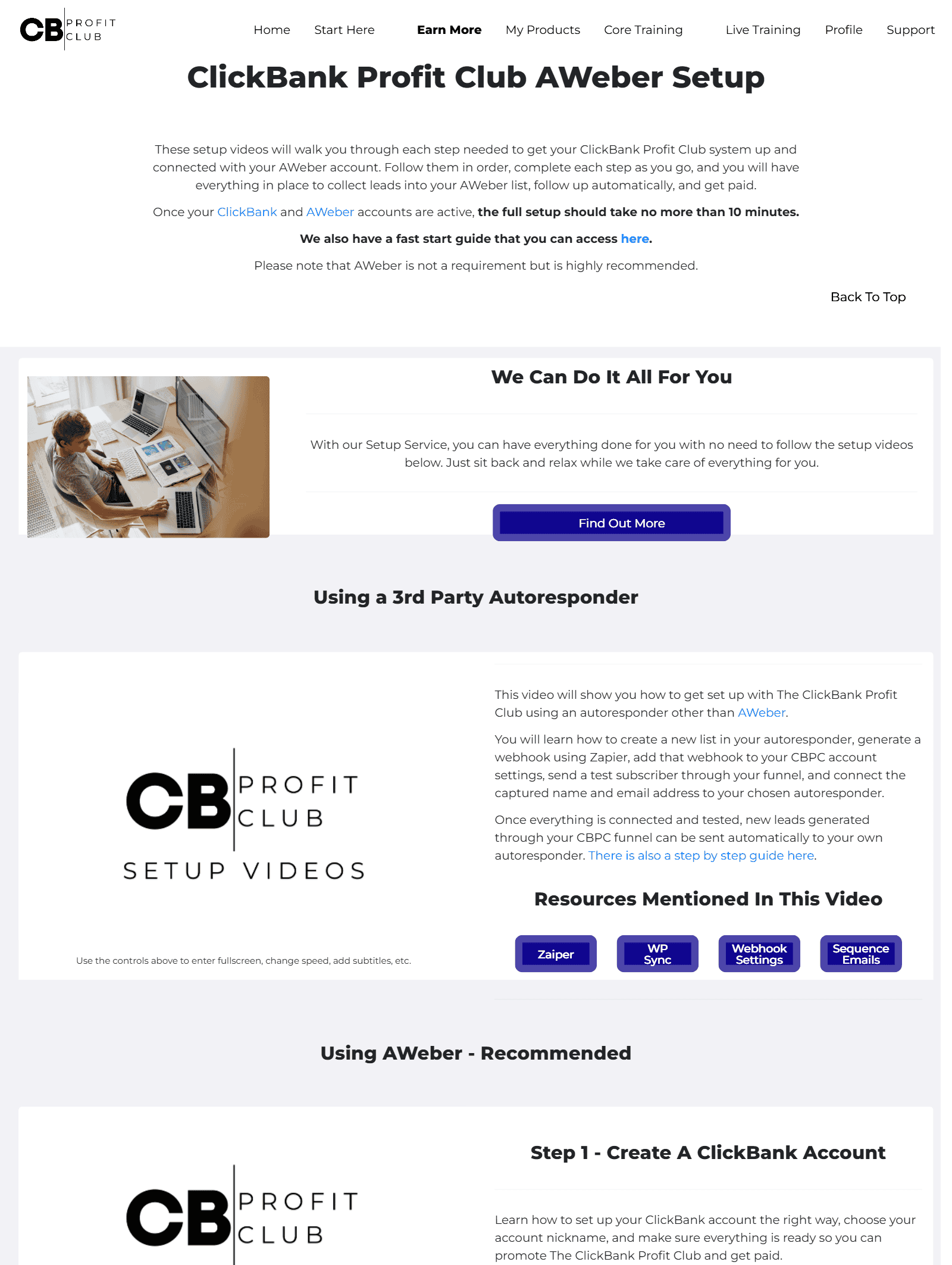
Want to know exactly what’s included at $0 and what’s locked? Read Is CB Profit Club free?
The rules you have to follow
Disclose that you earn commissions. In the US, the FTC requires you to tell people about your financial relationship clearly and close to the recommendation. Its own guidance says the closer the disclosure is to the link, the better, and that the words “affiliate link” alone aren’t clear enough. Something like “I earn a commission if you buy through links in this post” works. A note hidden in your footer doesn’t.
Follow each program’s terms. Common restrictions:
- no bidding on the brand’s name in Google Ads
- no coupon or cashback sites
- no spam
- no making income claims the vendor hasn’t approved
Break them and you can lose unpaid commissions along with the account, so read the terms before you promote.
How to start this week
- Pick a topic you can talk about for a year. If you can’t think of 50 posts or videos about it, pick something else.
- Join one or two programs, no more. Favour free programs with recurring commissions and no approval barrier. My list of beginner-friendly programs compares commissions, cookies and payout rules.
- Choose one traffic source from the table above, and commit to it for three months.
- Start collecting emails from the beginning, even if it’s just a simple sign-up form.
- Set up direct deposit and your tax details so your first payment isn’t held up.
- Disclose every affiliate link, every time.
- Track clicks and sales weekly. Double down on whatever actually brings sales, not likes.
The bottom line
You make money with affiliate marketing by connecting buyers with products and earning a share of each sale. The mechanics are simple and the payments are reliable: tracked links, clear commission rules, scheduled payouts.
What decides your income is traffic: how many of the right people see your recommendation, and how many chances you give them to buy. Pick a program that pays well and keeps paying, pick one traffic channel, and expect the first months to be slow.
Ready to choose where to start? Compare the commissions, cookie windows and payout rules in my list of the 10 best affiliate programs for beginners.
FAQ
How do affiliate marketers get paid?
By commission, paid by the merchant or network once your balance passes a minimum payout. Most programs pay by direct deposit, and some also offer check, wire or PayPal. ClickBank pays weekly or every two weeks. Amazon pays monthly, about 60 days after the month you earned it.
How often do affiliates get paid?
It depends on the program: weekly, every two weeks or monthly are the most common. You also need to pass the program’s minimum payout, and new commissions are often held until the refund period has passed.
Do affiliates get paid for clicks?
Almost never. Nearly all affiliate programs pay only when a click leads to a sale or, on some programs, a sign-up. Pay-per-click affiliate deals exist but are rare and pay very little.
Who pays the affiliate commission?
The merchant who sells the product. The customer pays the normal price, and the commission comes out of the merchant’s revenue. The network (such as ClickBank or Amazon) tracks the sale and sends you the payment.
Can you make money with affiliate marketing without followers?
Yes. Search traffic from a blog or YouTube, an email list, or a done-for-you funnel can all bring buyers without a social following. What you can’t skip is a reliable source of visitors.
How fast can you make money with affiliate marketing?
With paid ads, you can make a sale within days, though often at a loss while you learn. With SEO or YouTube, steady sales usually take several months. Add the program’s payment delay, and three to six months to a first payment is normal.
Do I have to pay taxes on affiliate income?
Yes. In the US, programs send a 1099 form once they pay you $2,000 or more in a year (for payments from 2026), but all affiliate income must be reported, including smaller amounts. Outside the US, you’ll usually complete a W-8BEN, and your own country’s tax rules apply.
Is affiliate marketing a scam?
No. It’s a standard way businesses pay for sales, used by Amazon, Shopify and most software companies. What is often misleading are courses and “systems” that promise fast, easy affiliate income. Real affiliate income depends on traffic and takes time.